
Reliability
How much can we trust it?
No forecast is perfect. aCaorle Meteo therefore measures errors, keeps different problems separate and becomes more cautious when evidence is not strong enough.
Real checks
local station · waitingVision Node · freshDPC HRD shadow · waitingverified nowcast events · 341
What does “Reliability” mean?
It is a summary, not a promise. It considers source agreement, freshness and past performance.
Sources agree and conditions are relatively stable. Local showers can still change quickly.
The forecast is useful, but spread is wider or some evidence is not yet confirmed.
Sources disagree, data are missing or the weather is highly unstable. Read the forecast more cautiously.
We do not hide everything inside one score
Temperature, rain and timing can behave differently. Good temperature performance cannot compensate for poor rain prediction.
🌡️Temperature
We measure the mean error in degrees against the local station.
☔Rain probability
We use Brier Score and calibration: over time, 70% should behave like a real 70%.
⏱️Rain onset
We measure how many hours early or late the forecast places the start of rain events.
🚨Nowcast
With enough events we count hits, false alarms, misses and real warning lead time.
Brier Skill: higher is better. A negative value means the simple reference used by the test performed better during the measured period, so rain calibration still deserves caution.
How we use observations
📷More reliable Skycams
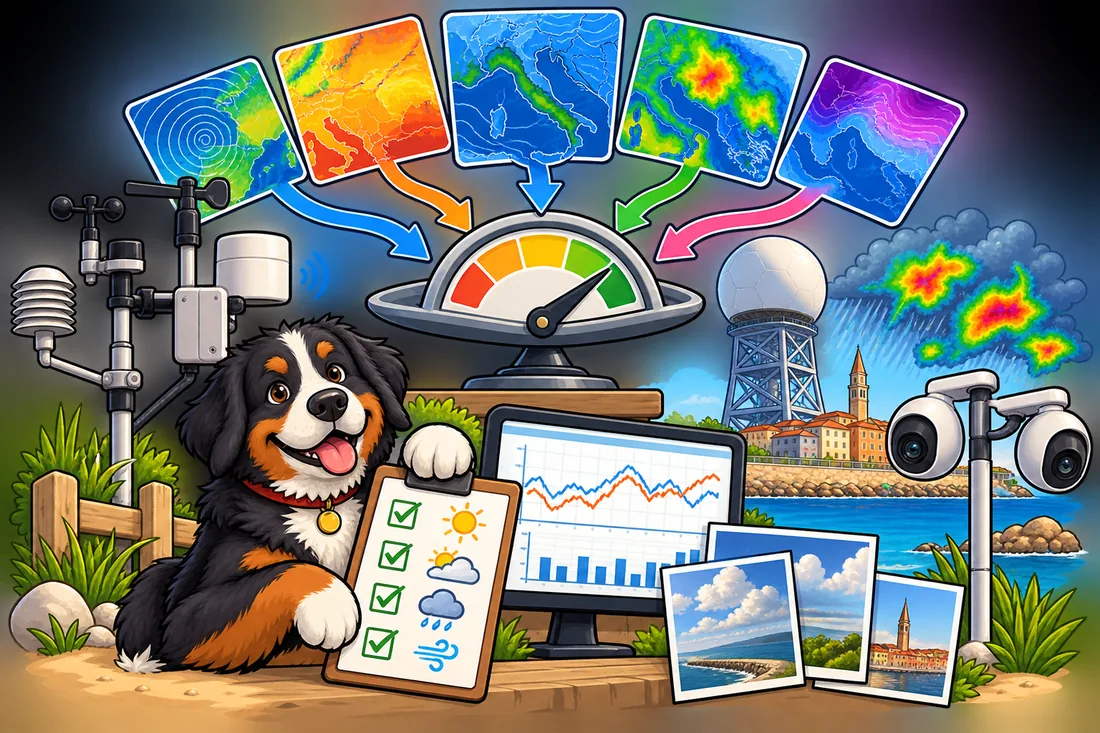
Vision Node corrects sky conditions only when both cameras are fresh and confidence passes quality gates.
☁️Cloud motion
Cloud Motion compares North and South, but remains apparent direction only; it is not converted into wind speed.
📡Richer radar checks
The precipitation map uses RainViewer. Civil Protection radar helps with checks. DPC heavy-rain detection is being evaluated.
🧪Shadow first, public later
New signals work in shadow before they can affect the public forecast.
The limit we cannot remove
Caorle is a narrow coastal strip: one shower can hit one area and miss another nearby. The goal is not to sound certain, but to be useful and explain uncertainty.